AI for Business Is Becoming a Visibility Layer
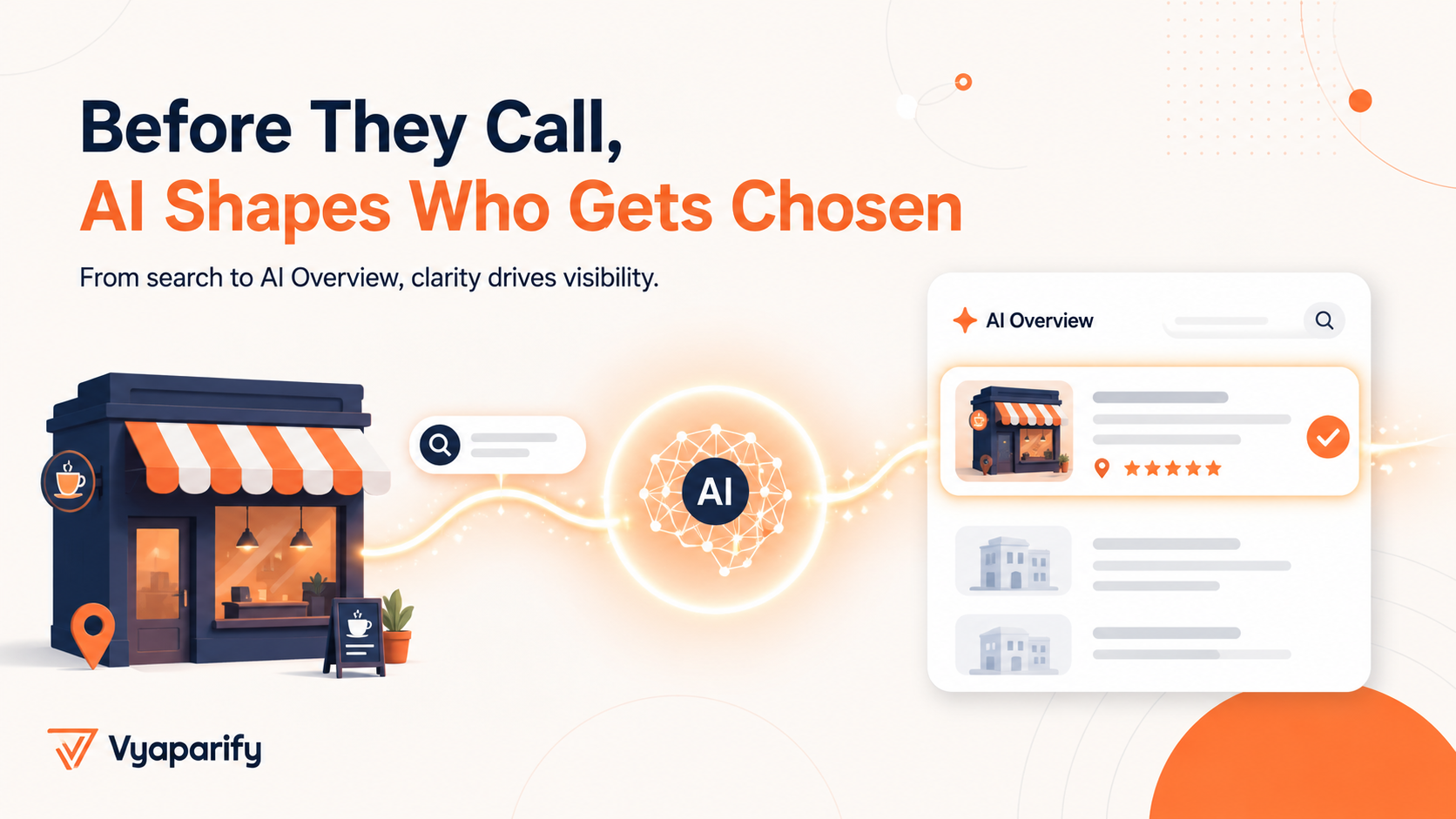
A customer in Pune needs an AC repair service urgently.
Earlier, he may have opened Google and searched, “AC repair near me.” He would compare a few listings, check phone numbers, maybe look at ratings, and call the business that looked active and reliable.
Now the same customer may ask an AI tool:
“Which AC repair service near me looks reliable and can come today?”
Or even in his searches AI will give them the top options in a summary.
That small change matters.
The customer is no longer only looking at search results. He is asking a system to compare, summarize, and suggest. Before he calls any business, AI may already shape which options feel trustworthy.
This is where the meaning of ai for business is changing.
For many business owners, AI still means writing captions, creating images, replying faster, or making marketing content. Those things are useful. But for small businesses, a bigger shift is starting.
AI is becoming part of how customers discover businesses.
That means the next challenge is not only, “How can my business use AI?”
It is also:
“Can AI understand my business clearly enough to include it, explain it, or recommend it?”
For Indian shop owners, service providers, clinics, salons, coaching classes, restaurants, boutiques, repair services, and local merchants, this is not a future problem. It is slowly becoming a visibility problem.
The old goal was ranking. The new goal is being understood.
For years, small businesses were told to focus on Google ranking.
Rank higher.
Get more clicks.
Get more calls.
Get more customers.
That still matters. Google Search and Google Maps remain important for local business discovery. But AI-powered search is changing how information is selected and shown.
A business can rank well on Google and still not be the clearest answer for AI.
Ahrefs found in one study that 76.10% of pages cited in Google AI Overviews ranked in Google’s organic top 10. Later, updated Ahrefs data from 863,000 SERPs showed only 38% of AI Overview citations came from top-10 pages. In simple terms, Google ranking and AI citation are connected, but they are no longer the same thing.
For a small business owner, the lesson is simple:
Ranking helps, but clarity decides how useful your business looks inside an AI-powered answer.
A dental clinic may rank for “dentist near me,” but if its page does not clearly explain treatments, timings, location, doctor experience, appointment options, and patient trust signals, AI may not have enough useful context to describe it properly.
A boutique may appear online, but if product categories, photos, size options, location, and WhatsApp enquiry details are missing, the business becomes harder to compare.
This is why Vyaparify looks at online presence differently.
A business page is not only a digital visiting card. It is a structured identity that helps customers, Google, Maps, and AI-powered systems understand what the business does and how a customer can take action.
AI answers can reduce normal clicks
The second shift is even more important.
AI search does not always behave like traditional search. In traditional search, the user sees links and chooses where to click. In AI-powered search, the user may get a summarized answer first.
That means some customers may make decisions before visiting a website.
Seer Interactive reported that organic click-through rate dropped 61% for informational queries where AI Overviews appeared. Pew Research also found that users clicked a traditional search result 8% of the time when an AI summary appeared, compared with 15% when no AI summary appeared.
This does not mean websites are dead. It means websites and business pages need to work harder at the point where AI reads them. Because now for them the Internet should answer everything.
If AI answers the customer directly, the business should aim to become part of that answer.
For a local business, this changes the job of online presence.
Earlier, the goal was:
“Get the customer to click.”
Now, the goal is also:
“Make the business clear enough to be understood before the click.”
That is why information quality matters.
A repair service should not only say “best repair service.” It should clearly mention AC repair, washing machine repair, refrigerator repair, service area, emergency availability, contact number, and booking method.
A restaurant should not only say “good food.” It should show menu items, ordering options, timings, address, delivery availability, and customer trust signals.
AI does not know your offline reputation unless your online information explains it.
Being online is not the same as being selectable
Many businesses already have some online presence.
They may have a Google Business Profile.
They may have an Instagram page.
They may have a phone number online.
They may have a few photos.
They may have a basic website or listing.
But AI-powered discovery needs more than scattered information.
AirOps reported that ChatGPT may retrieve many pages, but only about 15% of retrieved pages appear in final answers, meaning most pages that are read are not actually cited or selected. Another analysis referenced by BrandCited notes that 44.2% of LLM citations come from the first 30% of a page, which shows how strongly structure and early-page clarity can influence selection.
This gives small businesses a practical rule:
The most important business information should not be hidden.
It should appear early, clearly, and in customer language.
A good business page should quickly answer:
"If I was the customer what would I want the business to answer?"
This is the difference between being online and being selectable.
Vyaparify helps small businesses move from scattered information to a more complete online identity. Instead of keeping business details, products, services, offers, photos, and contact actions disconnected across different platforms, Vyaparify helps organize them into a customer-ready presence that supports Google visibility, local discovery, and future AI search behavior.
Old SEO visibility vs AI search visibility
Traditional SEO was mostly about ranking pages and getting clicks.
AI search visibility adds another layer.
Old visibility questionNew visibility questionDoes my business rank?Can AI understand what my business does?Can customers click my page?Can AI summarize my business correctly?Do I have keywords?Do I have clear business context?Is my website live?Is my information structured and complete?Do I appear on Google?Do I appear as a trusted option in decision moments?Do I get profile views?Do those views turn into WhatsApp, call, enquiry, or order actions?
This is why ai for business should not be treated only as a software topic.
For small businesses, AI is becoming a discovery layer, a trust layer, and a decision layer.
What this means for Indian small businesses
Indian businesses often have strong offline trust.
A local tailor may have loyal customers for 15 years.
A coaching teacher may be known by parents in the area.
A repair technician may get repeat calls through word of mouth.
A restaurant may have regular customers who love the food.
A travel agent may be trusted by families for ticket booking and tour planning.
But offline trust does not automatically become online trust.
When a new customer discovers the business through Google, Maps, AI search, or a shared link, they do not know the full story.
They only see what is available online.
If the business information is incomplete, the customer hesitates.
If services are unclear, the customer compares another option.
If photos are missing, the business may look inactive.
If contact options are confusing, the customer may not call.
If Google information is weak, local discovery suffers.
If AI cannot understand the business, it may not confidently mention it.
That is the real business problem behind ai for business.
It is not only about adding AI tools to the business.
It is about making the business clear enough for the new discovery environment.
Where Vyaparify fits in this shift
Vyaparify helps Indian small businesses create a stronger online identity without technical complexity.
This matters because AI search visibility begins with organized business information.
A merchant should not have to understand technical SEO, structured data, content systems, or AI search optimization before becoming discoverable.
The first step should be simpler:
Add the right business details.
Show products and services clearly.
Improve Google visibility.
Connect Google Business Profile.
Show trust signals.
Give customers easy action options.
Keep information updated.
Make the business easier to understand.
Vyaparify works as a practical bridge between offline trust and online discovery.
For a salon, Vyaparify can help showcase services, photos, and WhatsApp booking.
For a repair service, it can help display service categories, location, and call options.
For a coaching class, it can help explain courses, batches, enquiry flow, and trust details.
For a shop, it can help present products, offers, contact buttons, and order options.
For a local merchant, it turns basic business information into a more discoverable presence across Google, Maps, customer search journeys, and future AI-powered discovery.
The next customer may ask AI before calling you
The customer journey is changing quietly.
A person may still search on Google.
They may still check Maps.
They may still visit a business profile.
They may still click a website.
They may still call directly.
But now, they may also ask AI to shortlist options, explain differences, compare businesses, or suggest what to do next.
That means your business information has to work before the customer speaks to you.
It has to create clarity before the call.
It has to show trust before the enquiry.
It has to explain your products or services before the visit.
It has to make the next action obvious.
This is the new meaning of ai for business.
Not only faster content.
Not only automated replies.
Not only smarter tools.
For small businesses, AI is becoming a visibility layer.
And the businesses that explain themselves clearly online will have a better chance of being found, understood, trusted, and contacted.
The practical first step is simple:
Make your business clear enough for customers, Google, Maps, and AI search to understand.
Vyaparify helps small businesses start there.