AI for Business Is Moving From Separate Tools to One Intelligent System
A local café owner begins the day by checking WhatsApp enquiries, updating a changed menu price, reviewing Google messages, checking yesterday’s payments, and calling a supplier about low stock. None of these tasks is the reason the owner opened the café, yet a large part of the day is spent moving between systems that do not communicate with one another.
This is the real challenge behind digital transformation for small businesses. Merchants now have access to more software than ever, but they are still responsible for connecting it manually. One platform manages the business profile, another handles products, a separate app manages customer messages, while orders, payments, reviews, enquiries, and business information may all live in different places.
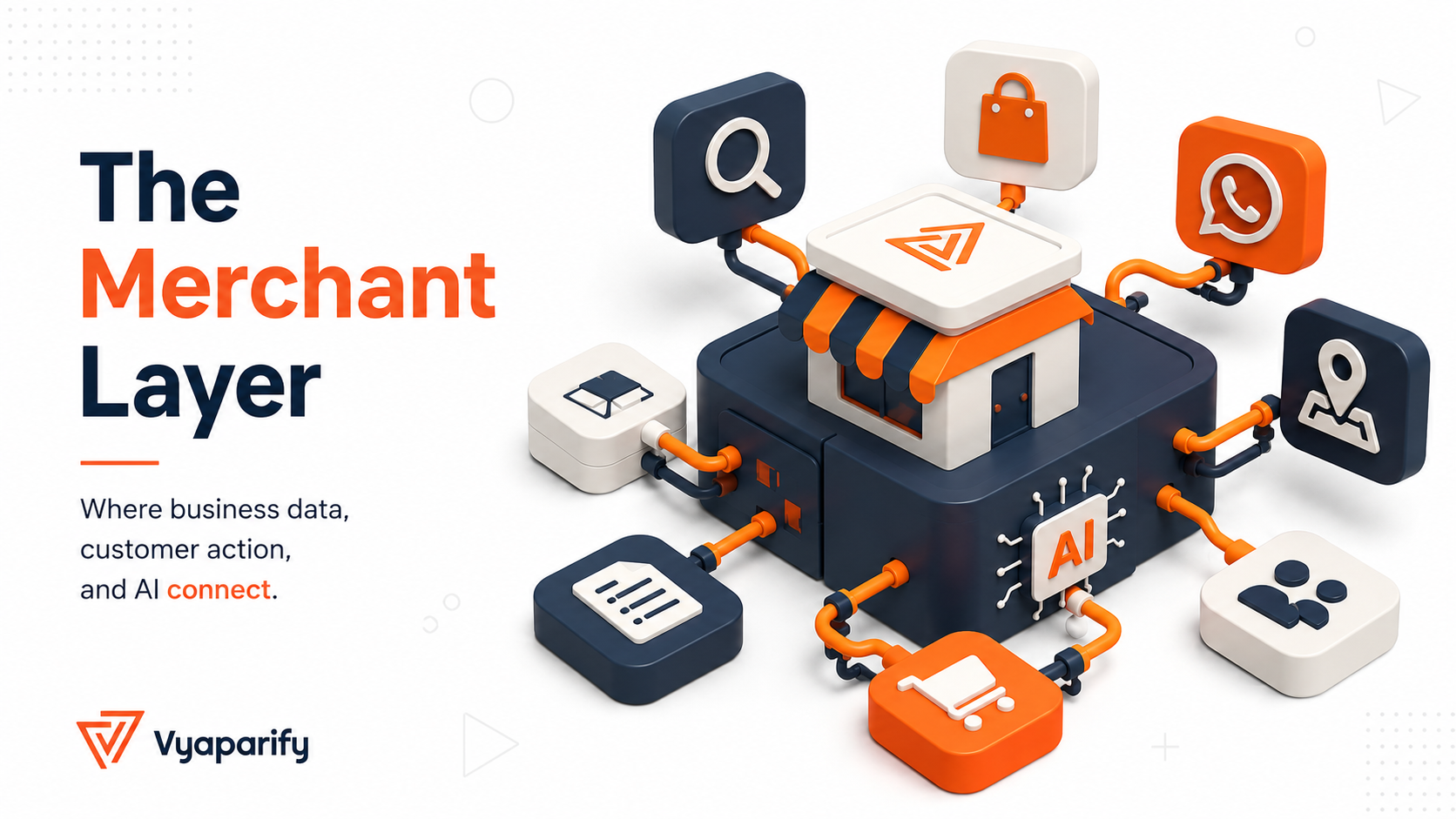
The next stage of AI for business will not simply add another tool to this list. It will create an intelligent layer that understands the business and helps these tools work together. Vyaparify is already moving in this direction by bringing a merchant’s business identity, products, services, visibility, and customer actions into one connected platform.
Small Businesses Do Not Need More Disconnected Tools
Most small-business technology is designed to solve one task at a time. A merchant may be told to create a website, build a Google Business Profile, open a WhatsApp Business account, post regularly on social media, upload products, collect reviews, accept digital payments, run online offers, and track customer enquiries.
Each recommendation may be useful on its own, but the real difficulty begins when every task requires a separate platform, login, workflow, and manual update. A simple product price change may need to be corrected across a website, social profile, catalogue, and messaging platform. Updated business hours may appear correctly in one place while another still shows the old timing.
As a result, the business may look digital from the outside while remaining fragmented behind the scenes. This creates repeated work for the merchant, inconsistent information for customers, and missed opportunities when the wrong detail appears at the wrong moment. AI for business becomes truly valuable when it reduces this coordination burden instead of adding another dashboard for the owner to manage.
AI Must Understand the Business Before It Can Automate It
Automation is often discussed as though the first step is simply assigning tasks to an AI agent. But an AI system cannot reliably recommend a product, answer a customer, create an offer, or update a catalogue unless it first understands the business it is working for.
That means the system needs a clear picture of the business, including its correct name, category, location, products or services, service areas, operating hours, and the actions customers can take. It should understand whether customers can call, message, enquire, book, order, pay, or visit.
This is why a complete online profile matters. It is not just a page containing business information; it is the foundation that helps customers, Google, Maps, and AI systems understand what the business is and why it may be relevant. Vyaparify already helps merchants create informative profiles, showcase products and services, and connect direct customer actions, creating the structured foundation that can support more intelligent automation over time.
What Vyaparify Is Building Today
Vyaparify is already bringing important digital-business elements into one platform. A merchant can build a complete online identity, showcase products and services, improve visibility across Google and Maps, and connect customers through WhatsApp, calls, enquiries, and orders.
The value is not only that these tools exist. The value is that they describe the same business. A customer should not see one version of the business on Google, another version on WhatsApp, and incomplete information on its online profile.
This connected foundation is also important for AI search visibility. AI systems can recommend a business more confidently when its name, category, location, products, services, hours, images, and customer actions are clear and consistent. Vyaparify is therefore helping create the information layer that both customers and AI systems can understand.
Where This Foundation Could Lead
The futuristic concept goes further. Once AI understands the business, its products, customers, and day-to-day activity, it could gradually support work that merchants currently manage manually. This may include creating catalogues and product descriptions, identifying missing information that reduces search visibility, and answering routine customer questions using approved business details.
Over time, AI could also recognise repeated demand for a product or service, suggest offers based on customer behaviour or seasonality, support supplier communication when inventory falls below a certain level, and help customers move more smoothly from discovery to enquiry, booking, payment, or order.
These possibilities should not be presented as though every form of autonomous commerce is already available. They represent the direction that becomes possible when business information, discoverability, customer actions, and operational data exist within one connected system. The digital foundation must come first, because automation becomes more useful only after that foundation is strong.
What AI Should Take Over
AI should take over work that is repetitive, predictable, and dependent on moving information between systems. This can include updating recurring business information, structuring products and services, publishing routine changes, answering common questions, monitoring customer patterns, identifying missing information, suggesting campaigns, supporting follow-ups, and coordinating standard workflows.
The merchant should continue to control decisions that require judgement, experience, and human understanding. These include maintaining product quality, building customer relationships, applying local knowledge, setting pricing strategy, choosing business priorities, managing supplier relationships, giving final approvals, and handling sensitive customer situations.
AI should not remove the merchant from the business. Its role should be to reduce unnecessary operational friction, handle repetitive coordination, and give the merchant more time to focus on customers, quality, relationships, and growth.
The Future Business Will Be Human-Owned and AI-Supported
The strongest use of AI for business will not be a chatbot added to one corner of a website. It will be a connected intelligence layer that understands the business and helps information move where it is needed.
The merchant may still create the product, serve the customer, negotiate important decisions, and protect the reputation of the business. AI can handle the repetitive coordination surrounding those moments.
Vyaparify is building the digital foundation for that future by helping merchants bring identity, products, services, visibility, and customer actions into one connected platform. The future of small-business technology is not about asking merchants to operate more tools. It is about creating a system that understands the business well enough to make those tools work together.