Building Offline Trust for an Online Presence
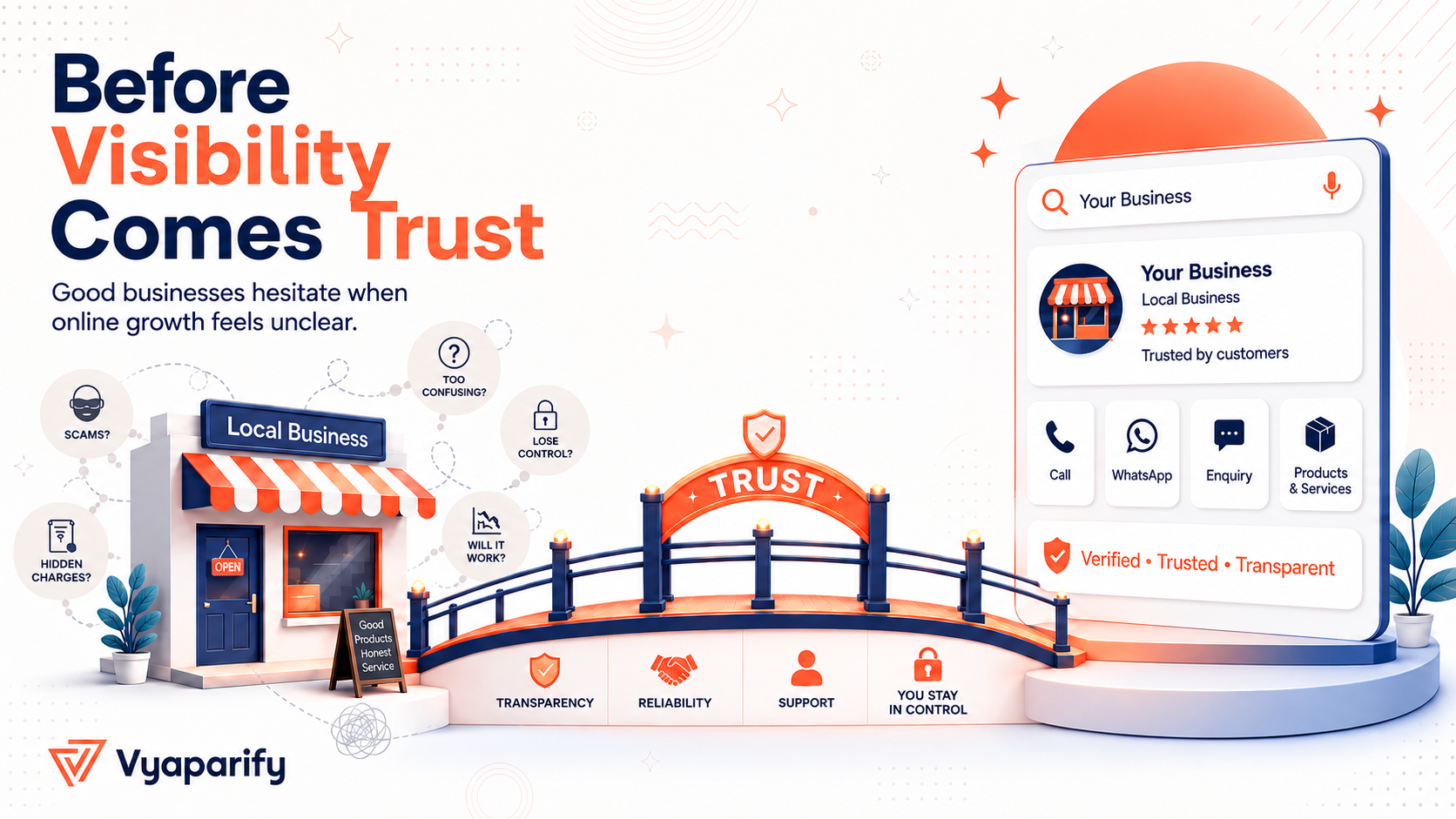
Small business owners want growth, but many are careful because online services often sound confusing, risky, or full of unclear promises. A shopkeeper who has built regular customers over many years does not want to lose control of that steady business because someone promised “online growth” without explaining what will actually happen. A service provider who gets work through referrals may not immediately trust a digital platform if they have already heard stories of fake calls, hidden charges, poor support, or no real results.
The Fear Behind the First Online Step
For many traditional businesses, the first online step is not only a business decision. It is a trust decision. They are not asking, “Can I grow?” They are asking, “Will this be safe for my business?” That question matters because local businesses often run on relationships, repeat customers, and word of mouth.
This is why many business owners do not start by looking for advanced digital marketing services. They look for something simple, low-risk, and easy to understand. A search like “business on google for free” is often not only about saving money. It is about testing whether online visibility can work without entering a confusing or expensive commitment.
For a local business owner, Google feels like a serious first step because customers already use it before calling, visiting, or asking for directions. But even then, the owner wants clarity. They want to know what will be shown, how customers will contact them, and whether this online presence will actually help without creating unnecessary complications.
Free Visibility Feels Safe, But It Is Not the Full Answer
Getting listed online may feel like the safest starting point, and in many ways, it is. It gives the business a basic presence and allows customers to find its name, location, and contact details. But simply appearing online does not automatically bring enquiries. A weak online presence can still leave customers unsure.
A business may show up in search results, but if the details are incomplete, the photos are old, the services are unclear, or the contact options are missing, customers may choose another business. This happens even when the first business is genuinely better offline. Online, customers do not always know the full story. They judge based on what they can see.
This is where many local businesses lose opportunities. They think the main goal is to appear on Google, but customers are usually making a deeper decision. They are checking whether the business feels reliable enough to call, visit, message, or order from.
A Listing Can Show Your Name, But Trust Gets the Call
A listing can tell customers that your business exists. Trust tells them whether they should contact you. This difference is important because local customers often make quick decisions. Someone looking for an AC repair service, boutique, clinic, cafe, coaching class, mobile repair shop, or furniture store may compare a few options and contact the one that feels easiest to understand.
For example, an AC repair business may already be trusted by customers in one area. But a new customer searching from another part of the city does not know that history. If they see only a business name and phone number, they may hesitate. If another business shows clear services, recent work photos, customer reviews, and a WhatsApp option, that second business may get the enquiry first.
The quality of the offline business may not be the problem. The problem is that the online presence has not carried that quality forward. Offline reputation needs proof online. Without that proof, new customers may not feel confident enough to take the next step.
Offline Reputation Needs an Online Shape
In local markets, reputation is built slowly. Customers remember who gave good service, who delivered on time, who spoke honestly, and who solved problems properly. But online customers do not always have access to that history. They need visible signals that help them understand the business quickly.
This is why small businesses need more than a name on Google. They need a simple online identity that explains who they are, what they offer, where they serve, and how customers can contact them. It does not have to be complicated. It only has to be clear.
A jewellery store can show its product range. A clinic can show its services and timings. A coaching class can show subjects, batches, and enquiry options. A home service provider can show service areas, photos, and contact buttons. These details help online visitors feel that the business is real, active, and approachable.
Clarity Is the New Shopfront
Earlier, a customer could stand outside a shop and understand many things immediately. The signboard, display, staff, crowd, and location all helped create trust. Online, the business profile becomes that first impression. If it is unclear, empty, or inactive, the customer may assume the business is not serious.
Clarity does not mean heavy design or complicated marketing. It means the customer should not have to guess. What does the business sell? Which services are available? Is the business open? Can I call directly? Can I message on WhatsApp? Is the location correct? Are there real photos? These simple answers can decide whether a customer continues or leaves.
Many small businesses already have strong offline value, but that value is not always visible online. A good online identity should make the business easier to understand, not more complicated. It should work like a digital shopfront that is open even when the customer is only searching from home.
Trust Signals That Make a Business Feel Active
Customers usually trust a business when they see signs of activity. Updated details, recent photos, clear product or service information, reviews, and easy contact options all help reduce doubt. These things may look small, but together they create confidence.
Photos are especially important because they make the business feel real. A shopfront photo, product photo, service photo, team photo, clinic photo, classroom photo, or work sample can help a new customer understand what to expect. The photos do not need to look expensive. They need to feel genuine.
Reviews also help because they act like digital word of mouth. For a customer who does not personally know the business, even a few genuine reviews can make the decision easier. Similarly, clear contact options matter because customers do not want friction. Some want to call, some want to message on WhatsApp, and some prefer sending an enquiry first.
This is also becoming important for AI search visibility. Search engines and AI systems understand businesses better when the information is clear and structured. Business name, category, location, services, products, contact options, and activity signals all help the business become easier to understand. Small businesses do not need to learn complex technology for this. They only need their online information to be complete, useful, and consistent.
Make Your Offline Trust Visible Online
The real opportunity for small businesses is not just to be online. It is to make their offline trust visible online. A business that already serves customers well should not look incomplete or inactive when a new customer searches for it. The online presence should support the trust the business has already built.
Vyaparify helps Indian small businesses create a simple online identity, improve Google visibility, showcase products and services, and connect with customers through WhatsApp, call, enquiry, or order options. The purpose is not to make digital presence feel heavy. Vyaparify's purpose is to make the business easier to find, easier to understand, and easier to contact.
For a small business owner, this kind of support matters because online growth should not begin with confusion. It should begin with clarity. Customers should be able to see what the business offers, feel that it is genuine, and contact it without difficulty.
Being found is only the first step. Being trusted is what brings the customer closer. If your business is already known offline, the next step is to make that trust visible online.