From Website to Connected Business: The Next Digital Step
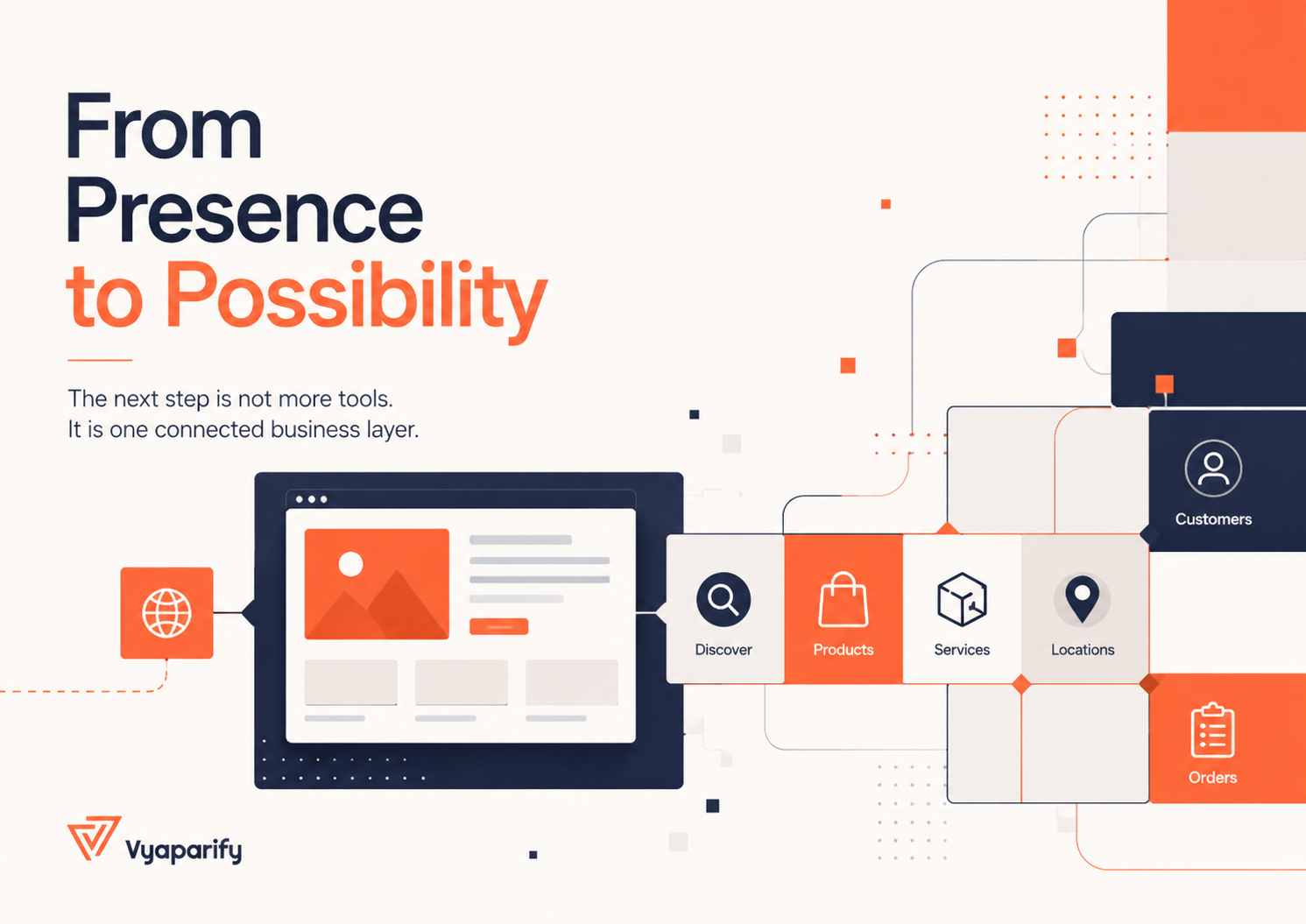
Creating a website is one of the most meaningful steps a small business can take towards online transformation. It gives the business a permanent identity that customers can visit, understand, and share.
For a local shop, service provider, home-based business, manufacturer, consultant, or traditional merchant, a website creates visibility beyond the physical location. Customers can explore products, understand services, check contact details, and decide what to do next.
But a website is not the end of digital transformation. It is the foundation on which a more connected business presence can be built.
Why a Website Is a Powerful First Step
Before creating a website, a small business often keeps its information in many different places. Product photographs may be stored on a phone, prices may be shared through WhatsApp, and business details may exist only on Google Maps or social media.
A website begins bringing this information into one organised destination. It allows the merchant to present the business name, products, services, location, contact details, operating hours, and customer-action options in a clearer format.
This creates a more professional experience for customers. Instead of depending only on word of mouth or repeated explanations, the merchant can share one link that helps people understand the business.
The Problem With Disconnected Digital Tools
Most small businesses do not lack digital tools. They may already use a website, Google Business Profile, WhatsApp, Instagram, UPI, online catalogues, and spreadsheets.
The challenge is that these tools often operate separately. The merchant must update products on the website, change hours on Google, share offers on social media, reply to enquiries on WhatsApp, and record orders somewhere else.
The business may be online, but it is not truly connected. The merchant remains the person responsible for making every platform and customer interaction work together.
What the Best Website Builder for Small Business Should Do
The best website builder for small business should do more than create attractive pages. It should help the merchant present the complete business in a way that is simple to manage and easy for customers to understand.
A useful platform should support products, services, location details, contact options, business hours, enquiries, appointments, orders, and other relevant customer actions. It should help turn a website visit into a clear next step.
The real test is not whether a merchant can launch a page quickly. It is whether the platform can become the structured centre of the business’s online identity.
The Connected Merchant Loop
A connected small-business system can be understood through six stages: Understand, Structure, Publish, Match, Act, and Learn. Together, these stages form the Connected Merchant Loop.
The loop begins by identifying what the business does, organising that information, and making it available through relevant channels. It then helps customers find the right offering and take the right action.
The final stage uses customer signals such as searches, enquiries, orders, and repeated questions to improve the next interaction. This turns a static website into the foundation of a more responsive business system.
Understand the Complete Business
A platform first needs to understand the business clearly. It must know what the merchant sells, which services are offered, where the business operates, and which customers it serves.
It should also understand business hours, service areas, product categories, customer preferences, and the actions available to a visitor. This context helps create a more complete online representation.
For example, an AC repair business should not simply say “AC service available.” Customers may need to know the brands covered, service locations, repair types, home-visit availability, and how to book.
Structure Business Information
Small businesses often possess valuable information, but it may not be organised. Product images, prices, service details, customer questions, and business descriptions may exist across phones, notebooks, chats, and social accounts.
Structuring this information turns it into product catalogues, service categories, business profiles, descriptions, offers, operating details, and clear customer-action paths.
This matters because customers, search engines, Maps, and AI-powered systems understand businesses more effectively when information is complete, accurate, and well organised.
Publish Information Where Customers Search
Once the information is structured, it needs to become visible across the places customers use. These may include the business website, Google Search, Google Maps, social platforms, and product or service pages.
Publishing does not mean placing random information everywhere. It means making approved and current business information visible through the channels that matter most.
Consistency is important. When the website shows one phone number, Google shows another, and WhatsApp contains an outdated price, customers may lose trust before contacting the business.
Match Customer Intent With the Right Offering
Customers rarely search for a general business category without a specific need. They may search for an eggless cake in a particular location, urgent laptop repair, a home tutor, or a nearby tailor offering alterations.
The business must provide enough detail for the customer to recognise that it offers the right product or service. Location, availability, category, specialisation, and service details all help create a stronger match.
As search becomes more conversational and AI-driven, clearly structured business information may become even more important. Digital systems need reliable context before they can connect a customer with a suitable merchant.
Enable Customers to Take Action
Visibility only becomes commercially valuable when the customer can take the next step. A website should make the appropriate action easy to identify and complete.
Depending on the business, this action may be a phone call, WhatsApp message, enquiry, quotation request, appointment, order, payment, or store visit.
A tuition teacher may need appointment enquiries, while a restaurant may need directions and ordering options. The best website builder should support actions that fit the actual business model.
Learn From Searches and Enquiries
Customer behaviour provides useful signals about what the market wants. Repeated searches, frequently asked questions, popular products, and common enquiries can reveal gaps in the business information.
A merchant may discover that customers frequently ask about delivery areas, stock availability, weekend appointments, customisation, payment methods, or service timelines.
Today, merchants often identify these patterns manually. In the future, a connected intelligent layer may help organise these signals and suggest ways to improve business information and customer journeys.
How This Works for an Indian Small Business
Consider Neha, who runs a home-based bakery in Indore. Her cake photographs are on Instagram, prices are shared through WhatsApp, payments arrive through UPI, and custom orders are recorded in a notebook.
Creating a website helps her present cake categories, sample designs, delivery areas, ordering details, and contact options in one place. This immediately improves how customers understand the business.
However, Neha must still coordinate availability, prices, customer messages, payments, and orders manually. The website creates the foundation, but a connected system can help the entire customer journey work more smoothly.
What Vyaparify Helps Merchants Do Today
Vyaparify helps merchants build a more complete online presence instead of creating only an isolated webpage. It brings important business information, products, services, discoverability, and customer actions closer together.
Today, merchants can use Vyaparify to create an online business profile, build a professional website, showcase products and services, and present important business details clearly.
They also supports visibility across Google and Maps, strengthens the foundation for AI search discoverability, and helps customers connect through WhatsApp, calls, enquiries, appointments, or orders.
What Connected AI Commerce Could Make Possible
The future of AI for business should not mean giving merchants another disconnected tool. It should mean creating one intelligent layer that understands the business and helps existing tools work together.
A future connected layer could help organise product information, suggest catalogue improvements, answer repetitive questions using approved details, identify demand patterns, and match customers with suitable merchants.
These are future possibilities rather than claims that every capability is available today. Merchants should remain in control of business information, customer relationships, approvals, and important commercial decisions.
Seven Questions to Ask Before Choosing a Website Builder
First, ask whether the platform can represent the complete business. It should support products, services, contact details, location, hours, photographs, offers, and other relevant information.
Next, consider whether customers can easily find the business and take action. The platform should support Google visibility, local discovery, WhatsApp, calls, enquiries, appointments, or orders where appropriate.
Finally, ask whether the system will remain useful as digital discovery evolves. A well-structured business presence creates a stronger foundation for search engines and future AI systems to understand the business.
A Website Is the Foundation, Not the Finish Line
A website is a great start because it turns offline business knowledge into a structured online identity. It helps customers understand what the business offers and how to connect.
The next stage is to connect that identity with products, services, Google visibility, Maps, WhatsApp, enquiries, orders, and other customer actions.
The future will not be about giving merchants more disconnected tools. It will be about creating one intelligent layer that understands the business and helps those tools work together.