Small Towns, Big Carts: Why WhatsApp Is Becoming India’s Conversational Storefront
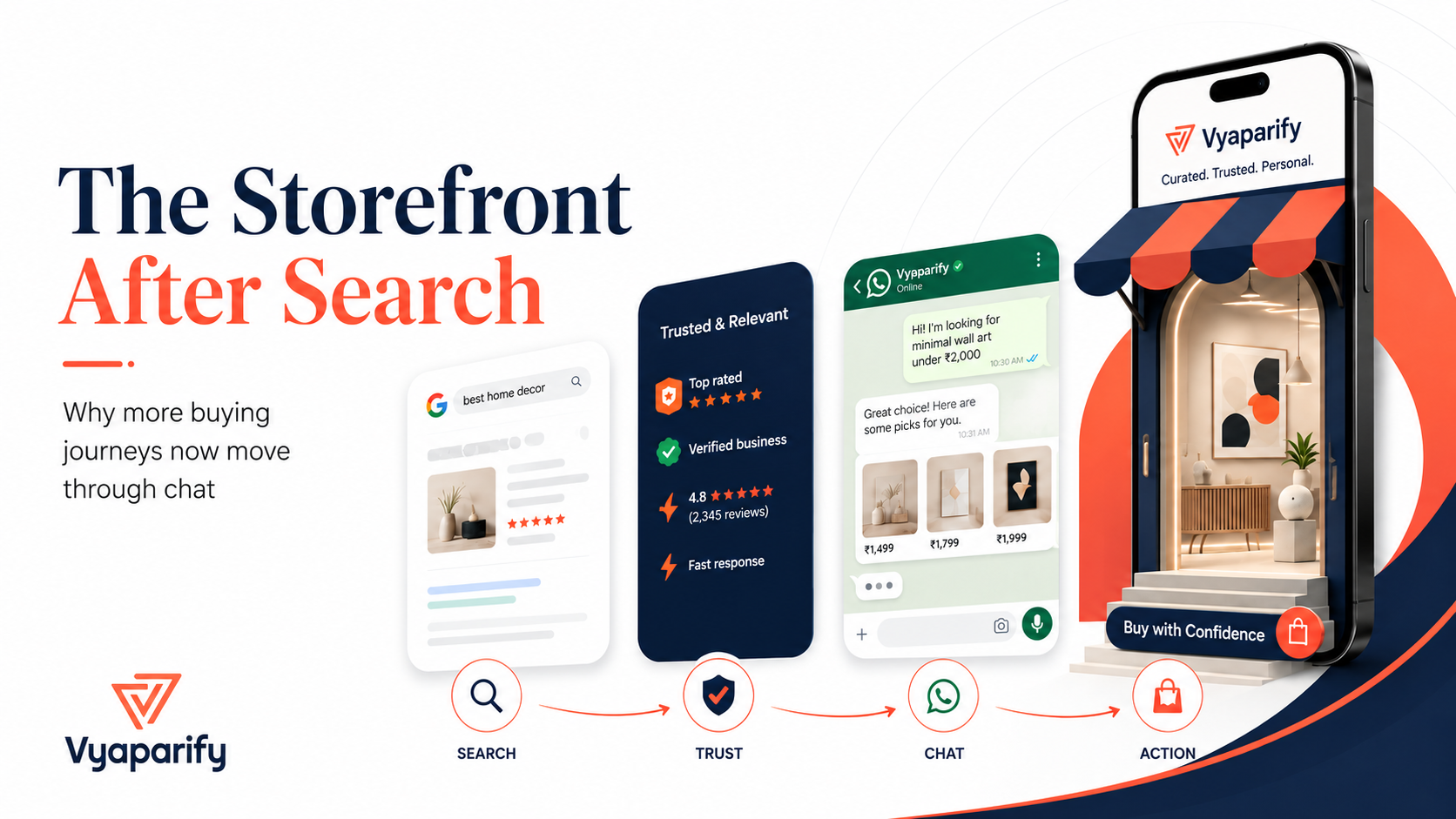
A customer in Ranchi discovers a home décor seller through Google. She checks a few product images, opens the business’s WhatsApp chat and asks whether a lamp can be delivered before the weekend.
The seller confirms availability, shares a short product video and sends the payment details. The customer pays digitally and receives the product through local delivery.
It was an online purchase, but it did not follow the conventional e-commerce path.
There was no marketplace search, lengthy product comparison or complicated checkout. The transaction moved through search, business information, conversation, payment and delivery.
This journey is becoming more relevant as India’s online-shopping growth moves beyond its largest cities.
Bain & Company reports that three out of every five new online shoppers added since 2020 came from Tier-3 cities or smaller locations. Its 2026 research also says Tier-2-and-beyond markets contributed approximately 65% of incremental shopper growth.
For small businesses, this shift creates an important question: Is a WhatsApp business account becoming the new online store?
The more accurate answer is that WhatsApp is becoming an important part of the store—but not the entire store.
The growth is not just geographic
Tier-2 and Tier-3 customers are not simply repeating the purchasing behaviour of metropolitan shoppers.
They may use the same smartphones, payment systems and delivery networks, but their route to a purchase can be more conversational.
A customer may see a product on Instagram but check the seller on Google before sending a message. Another may find a service through Maps, enquire through WhatsApp and visit the business physically. Someone may request real product images before making a UPI payment.
The stages remain digital, even when they happen across different platforms.
This matters because smaller cities are now contributing significantly to direct-to-consumer growth. Unicommerce data reported in April 2026 indicated that Tier-2 and Tier-3 cities generated 66% of new D2C orders in FY26 and approximately 60% of incremental gross merchandise value compared with the previous financial year.
The story behind these figures is not merely that more parcels are reaching smaller pin codes.
Online commerce itself is becoming more distributed.
Conversation solves the gap between interest and action
Traditional e-commerce attempts to answer every question through the product page and checkout interface.
Local commerce often works differently.
A customer looking at a dress may want to know whether the actual colour matches the photograph. Someone booking an appliance repair may need confirmation that the technician covers their neighbourhood. A parent considering a coaching centre may want to ask about timings before paying a fee.
These questions are not obstacles to digital commerce. They are part of the buying process.
A WhatsApp business account gives a merchant a familiar place to answer them. The business can present its identity, organise customer conversations and support actions such as enquiries, appointments and orders.
WhatsApp has also continued to expand the commercial actions businesses can offer. Meta has introduced features supporting appointments, ordering, payments and other business interactions within chats, while newer initiatives in India include AI-assisted responses and lead capture for eligible small businesses.
However, the chat usually begins only after the customer has found a reason to trust the business.
What many businesses misunderstand
Some merchants open a WhatsApp Business profile and expect new customers to begin messaging them.
But WhatsApp generally captures demand after discovery. It does not automatically create all that demand.
Before sending a message, a customer may still ask:
Does this business appear on Google?
Is it located near me?
Does it sell the product I need?
Are its timings and contact information accurate?
Can I see credible images, services or customer reviews?
Is there enough evidence that it is active?
This becomes equally important as AI-assisted search grows. WhatsApp Business isn't made to spread the word about you it exists majorly as an important step after contact is made and discovery has occurred.
Search engines and AI systems need structured, consistent and publicly understandable information before they can confidently connect a business with a customer’s query. A private chat may help convert the customer, but much of the information inside that chat is not the business’s searchable public identity.
The practical objective is therefore not to choose between Google, a website or WhatsApp. It is to connect them.
Local businesses have advantages national brands cannot copy easily
A boutique in Jaipur may reply in Hindi, share a real product video and arrange same-day delivery.
A repair professional in Coimbatore may quickly explain whether a particular area is covered.
A furniture seller in Guwahati may invite the customer to inspect the product physically after discovering it online.
These businesses can combine digital convenience with regional language, physical access, local knowledge and human reassurance.
That combination can be particularly valuable in markets where online discovery is increasing faster than familiarity with every individual seller. And using this combined with a digital stage will set small businesses ahead in the categories most brands are far behind in.
The local business does not need to imitate a large marketplace. It needs to make its own strengths easy to discover and act upon.
Connecting the storefront before the conversation begins
This is the role Vyaparify sees for a connected online presence.
A small business should be understandable before the first message is sent. Its identity, location, products, services and customer-action options should work together across Google, Maps, AI search, its online profile and communication channels.
Vyaparify helps merchants create that discoverable layer and connect it with direct actions such as WhatsApp, calls, enquiries and orders.
The value is not simply in adding another button.
It is in creating a clearer path:
A customer finds the business, understands it, verifies it, starts a conversation and takes action.
India’s next online store may not look like a store
India’s non-metro e-commerce growth is changing more than the location of the customer.
It is changing the shape of the transaction.
The next purchase may begin on Google, move to WhatsApp, use UPI for payment and finish through local delivery or a physical visit. No single platform owns the entire journey.
A WhatsApp business account is valuable because it brings human conversation into that journey. But the strongest businesses will connect the chat with everything that comes before and after it.
For local merchants, the opportunity is not to become present everywhere without a plan. It is to build one connected storefront across the places where customers discover, verify, message and buy.