The Local Customer Journey Has Changed. Has Your Business?
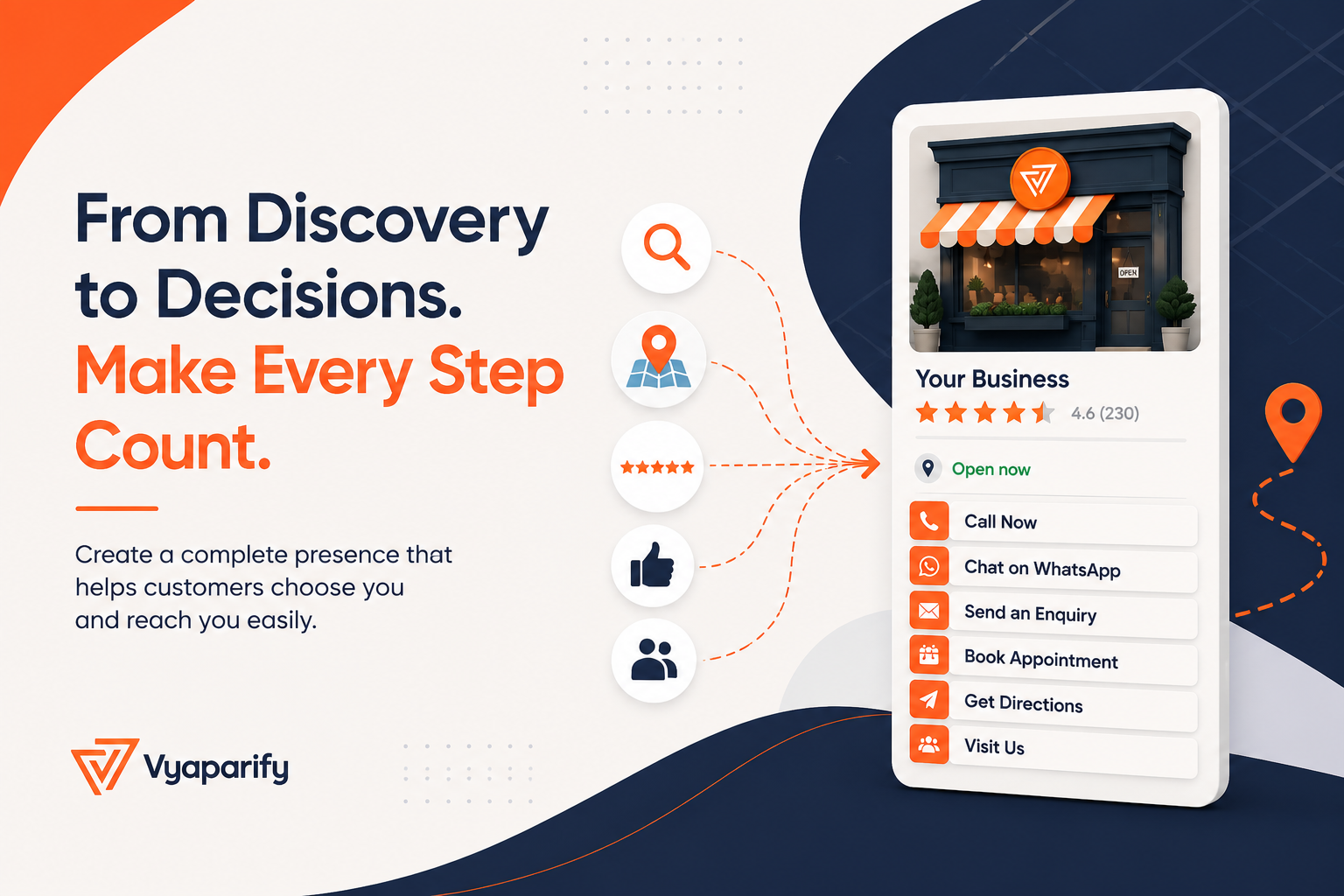
Local Business Promotion Now Begins Before the Customer Calls
Local business promotion once meant banners, newspaper advertisements, flyers, festival discounts, and word-of-mouth recommendations. These methods still matter, but they are no longer the only places where customers discover and evaluate nearby businesses.
Today, someone searching for a salon, clinic, repair service, tutor, bakery, clothing store, or home-based business may begin with Google Search. They may then open Maps, read reviews, visit the business website, check social media photographs, examine current offers, and finally call or send a WhatsApp message.
This means promotion is no longer just about getting attention. It is about creating a complete journey that helps customers find the business, understand what it offers, trust the information, and take the next step.
Local Discovery Now Happens Across Multiple Channels
Customers no longer depend on one platform when researching a nearby business. They may move between search engines, Maps, social media, review platforms, business websites, and increasingly AI-based recommendation tools.
BrightLocal’s 2025 consumer research reflects this shift. Local discovery is becoming more distributed, with people using a mix of platforms instead of relying only on traditional search results.
For the customer, these platforms are part of one decision. For the merchant, however, they are often separate accounts that need to be updated, connected, and managed manually.
Being Online Is Not the Same as Being Discoverable
A business can have a Google Business Profile, an Instagram page, a WhatsApp number, and a website and still remain difficult to understand. Having digital accounts only proves that the business exists online.
Being discoverable means that customers and search systems can clearly understand what the business offers, where it operates, when it is available, and which customer needs it can solve.
A vague description, incomplete product catalogue, outdated opening hours, or missing service area can make a business less useful even when it appears in search results.
Being Discoverable Is Not the Same as Being Actionable
A customer may find the business and still leave without contacting it. This often happens when the next step is unclear or requires too much effort.
The customer may need to search for the phone number, ask whether the business serves their area, confirm whether a product is available, or message repeatedly for prices and operating hours.
An actionable business presence gives customers a clear route to call, WhatsApp, enquire, book an appointment, request a quotation, place an order, get directions, or visit.
Customers Read Beyond the Star Rating
Reviews are an important trust signal, but customers do not judge businesses only by the average rating displayed next to the name.
BrightLocal’s Local Consumer Review Survey found that people read the details of both positive and negative reviews to form their own opinion. They look for information about service quality, reliability, behaviour, price, waiting time, product quality, and how problems were handled.
This means merchants should focus on creating genuine customer experiences rather than simply trying to collect five-star ratings. Detailed and authentic reviews can communicate far more than a number alone.
Authentic Business Information Is Becoming More Valuable
The rise of AI-assisted discovery does not reduce the importance of real customer experiences. It increases the value of accurate, detailed, and trustworthy information.
Yelp reports that users have contributed more than 330 million reviews across restaurants, salons, boutiques, dentists, mechanics, and other local businesses. Its AI assistant uses this large collection of customer experiences to answer specific questions and recommend suitable businesses.
The technology may be new, but the foundation remains familiar. AI can only make useful recommendations when it has reliable information about the business, its services, location, quality, availability, and customer experience.
The Merchant Is Still Connecting Everything Manually
Most local businesses use separate tools for their website, Google Business Profile, Maps presence, WhatsApp conversations, social media, payments, enquiries, appointments, and orders.
Whenever business information changes, the merchant must remember where it appears. A new product may need to be added to the website, posted on social media, shared on WhatsApp, and explained again to customers.
Each tool may be useful, but the business owner becomes responsible for making them work together. This creates extra workload and increases the chances of outdated or conflicting information.
Local Business Promotion Needs a Connected System
A stronger approach begins by understanding the business properly. The merchant must clearly identify the products, services, location, customer groups, operating hours, availability, and possible customer actions.
The information must then be structured into business profiles, categories, descriptions, catalogues, photographs, offers, prices, service areas, and contact paths.
Once organised, it can be published across relevant channels, matched with customer intent, connected to customer actions, and improved using information from searches, enquiries, orders, and repeated questions.
Understand What Customers Need to Know
Many small businesses describe themselves too broadly. A repair business may simply write “all types of repair,” while a consultant may list only “business services.”
Customers search with specific needs. They may look for refrigerator repair, bridal makeup, maths tuition, custom cakes, dental implants, or home-delivery groceries.
Clear business categories, specific service descriptions, product details, location information, and customer-use cases make the business easier to understand and more relevant to the right search.
Structure Products, Services, Offers, and Details
Business knowledge often remains scattered across WhatsApp chats, product photographs, handwritten notes, and the owner’s memory.
Structuring this information means giving each product or service a clear name, category, description, image, price range, availability, and appropriate next step.
Offers should also include clear conditions and validity dates. Operating hours, location details, service areas, and contact information should be organised in a consistent format.
Publish Accurate Information in the Right Places
Publishing does not mean creating an account on every platform. It means choosing the channels customers actually use and providing accurate information on each one.
Google Business Profile and Maps can support local discovery and quick decisions. Social media can show activity, products, and visual proof. WhatsApp can support direct conversations.
The business website can hold the most complete version of the business, helping customers move from basic discovery to deeper research and action.
Match Customer Intent With the Right Offering
Customers do not always search for the name of a business. They search for what they need, where they need it, and sometimes when they need it.
A person may search for “AC repair near me,” “salon open now,” “custom cake delivery in Indore,” or “dentist for root canal in Pune.”
Clear product names, service descriptions, business categories, location details, and website pages help digital platforms understand when the business may be relevant to these searches.
Make the Next Customer Action Obvious
Every important product, service, offer, or business page should lead to an action that matches the way the business operates.
A clinic may need appointment booking. A wholesaler may need quotation requests. A salon may need WhatsApp and calling options. A local retailer may benefit from directions, product enquiries, and ordering.
The goal is not to force every merchant into the same online model. It is to remove confusion from the customer’s next step.
Learn From Searches, Questions, and Enquiries
Repeated customer questions reveal what information is missing. If customers regularly ask about location, delivery, price, availability, or service areas, these details may not be clear online.
Searches and enquiries can also reveal which products or services are attracting the most interest. Orders and appointment requests can show which promotional activities lead to useful business outcomes.
Local promotion should therefore operate as a learning cycle. Each customer interaction should help the merchant improve the next version of the business presence.
Why the Website Still Matters
Search engines, Maps, reviews, social media, and AI tools have expanded the customer journey, but they have not made the business website outdated.
A website remains a merchant-controlled destination where products, services, offers, business information, photographs, policies, enquiries, appointments, and orders can be presented together.
It gives customers more depth than a short social profile or map listing and provides a reliable destination for other discovery channels to send interested customers.
An Indian Small-Business Example
Consider a home-based baker in Indore who has an Instagram page, a Google Business Profile, a WhatsApp number, and a simple website.
Her photographs attract attention, but customers still need to ask about flavours, delivery areas, advance-order time, price ranges, and customised designs.
A connected business presence would organise these details clearly, display current offers, explain ordering conditions, and guide customers directly toward WhatsApp, enquiry, or ordering.
Where Vyaparify Fits Today
Vyaparify helps merchants create complete online business profiles and publish professional business websites. Businesses can showcase their products, services, photographs, offers, operating details, and contact information in one organised digital presence.
Vyaparify also helps merchants connect customers through WhatsApp, calls, enquiries, appointments, and orders, depending on the business setup.
The platform does not guarantee Google rankings or automatically control every external digital channel. Its present value is in helping merchants build a stronger, clearer, and more actionable foundation for online visibility.
What Connected AI Commerce May Enable Later
AI tools may increasingly help customers ask detailed questions, compare options, and discover relevant businesses through conversational searches.
In the future, connected AI systems may help understand a business and its operating context, organise catalogues, suggest better descriptions, support repetitive enquiries, identify demand patterns, and match customer intent with suitable merchants.
These possibilities are still developing. They should not be confused with features that are universally available today, but they reinforce the need for accurate and structured business information.
The Future Is Not Another Disconnected Tool
Small-business owners already manage enough apps, dashboards, profiles, and communication channels. AI for business should not mean adding one more disconnected system.
It should eventually create an intelligent layer that understands the business and helps websites, profiles, catalogues, customer conversations, and transaction tools work together.
The first step toward that future is practical: organise the business, publish accurate information, build trust, and make every discovery channel lead toward a clear customer action.
Local Promotion Must Lead Somewhere
Successful local business promotion is no longer measured only by how many people see an advertisement or social media post.
It depends on whether customers can discover the business, understand what it offers, trust the information, and move easily toward a call, WhatsApp message, enquiry, appointment, order, or visit.
Businesses do not need more disconnected visibility. They need one connected presence that turns local discovery into real customer action.